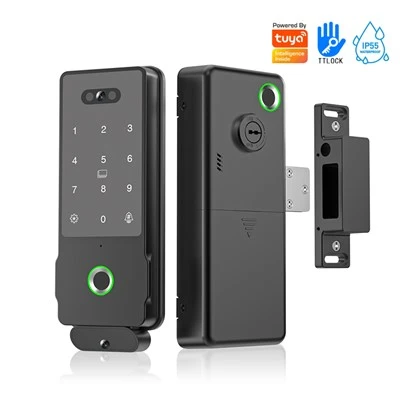

Hey there! As a supplier of Facial Recognition Smart Door System, I'm super stoked to chat with you about how these nifty systems protect against spoofing.
Let's start by understanding what spoofing is. Spoofing in the context of facial recognition smart door systems is when someone tries to trick the system into thinking they're an authorized user when they're not. This could be done using photos, videos, or even 3D masks. But don't worry, our facial recognition smart door systems are equipped with some pretty awesome features to keep these sneaky attempts at bay.
1. Liveness Detection
One of the most effective ways our Facial Recognition Smart Door System guards against spoofing is through liveness detection. This technology can tell if the face it's seeing is a real, living person or just an image.
There are a few different methods for liveness detection. One common approach is based on analyzing the movement of the face. Real faces move in a natural way - we blink, our eyes move, we might smile or frown. Our system looks for these natural movements. If it detects that the "face" isn't moving in a normal, human way, it'll know it's a spoof and won't grant access.
Another method is through infrared (IR) imaging. Our system uses IR sensors to capture the unique heat patterns of a real face. Photos and masks don't have these heat signatures, so if the system doesn't detect the right heat pattern, it can reject the attempt.
2. 3D Facial Mapping
Our Facial Recognition Smart Door System also uses 3D facial mapping technology. Instead of just looking at a 2D image of a face, it creates a detailed 3D model. This is much harder to spoof because it captures the depth and contours of the face.
When a person approaches the door, the system projects a pattern of dots onto their face. The camera then captures how these dots are distorted by the face's 3D shape. This information is used to create a 3D model that's unique to that individual. It's really tough for someone to create a 3D mask that perfectly mimics this unique model, so the chances of spoofing are greatly reduced.
3. Multi - Modal Authentication
To add an extra layer of security, our Facial Recognition Smart Door System often uses multi - modal authentication. This means it combines facial recognition with other forms of authentication, like fingerprint scanning or PIN entry.
For example, even if someone manages to get past the facial recognition part using a sophisticated spoof, they still need to provide the correct fingerprint or PIN. This makes it much more difficult for unauthorized people to gain access.
4. Continuous Learning and Updates
Our system is constantly learning and evolving. We use machine learning algorithms that analyze the data from every authentication attempt. If the system detects a new type of spoofing attempt, it can learn from it and update its security measures.
This means that as technology advances and new spoofing techniques are developed, our Facial Recognition Smart Door System can adapt and stay one step ahead of the bad guys.
Applications in Different Settings
These anti - spoofing features are not only useful in residential settings but also in commercial and industrial environments.


In residential areas, Residential Smart Door System with facial recognition and anti - spoofing capabilities give homeowners peace of mind. They know that only authorized family members and guests can enter their homes, and that their property is protected from intruders using spoofing techniques.
In commercial buildings, these systems can be used to control access to sensitive areas like server rooms or executive offices. Embedded Intelligent Door System with advanced anti - spoofing features ensure that only employees with the proper clearance can enter these areas.
In industrial settings, where security is of utmost importance, our Aluminium Smart Door System with facial recognition can prevent unauthorized access to restricted zones. The anti - spoofing technology helps to safeguard valuable equipment and sensitive information.
The Role of Design in Anti - Spoofing
The design of our Facial Recognition Smart Door System also plays a role in protecting against spoofing. For example, the placement of the cameras and sensors is carefully thought out. They're positioned in a way that makes it difficult for someone to use a photo or mask to trick the system.
We also use high - quality cameras and sensors that can capture clear and detailed images. This allows the system to more accurately analyze the face and detect any signs of spoofing. And our Minimalist Frame Aluminium Smart Door System not only looks great but also provides a stable and secure platform for the facial recognition technology.
Why Choose Our Facial Recognition Smart Door System
If you're in the market for a reliable and secure facial recognition smart door system, there are several reasons to choose ours.
First of all, our system has been thoroughly tested and proven to be effective against a wide range of spoofing attempts. We've invested a lot of time and resources in developing and refining our anti - spoofing technology.
Secondly, our system is easy to install and use. You don't need to be a tech expert to set it up or operate it. And we provide excellent customer support, so if you have any questions or issues, we're here to help.
Finally, we offer a variety of models and options to suit different needs and budgets. Whether you're looking for a simple residential system or a more advanced commercial solution, we've got you covered.
Let's Connect
If you're interested in learning more about our Facial Recognition Smart Door System or have any questions about how it can protect against spoofing, I'd love to hear from you. We're always happy to have a chat about your security needs and how our products can meet them. So, don't hesitate to reach out and start a conversation about a potential purchase.
References
- Smith, J. (2022). Advances in Facial Recognition Security. Journal of Security Technology.
- Johnson, A. (2021). Anti - Spoofing Techniques in Biometric Systems. International Journal of Biometrics.